Saree Photoshoot Cost in India: A Real Breakdown
What a saree photoshoot costs in India and why: draping takes 30 to 45 minutes per piece. Per-saree pricing, shoot-day yield and 200-saree catalog maths.
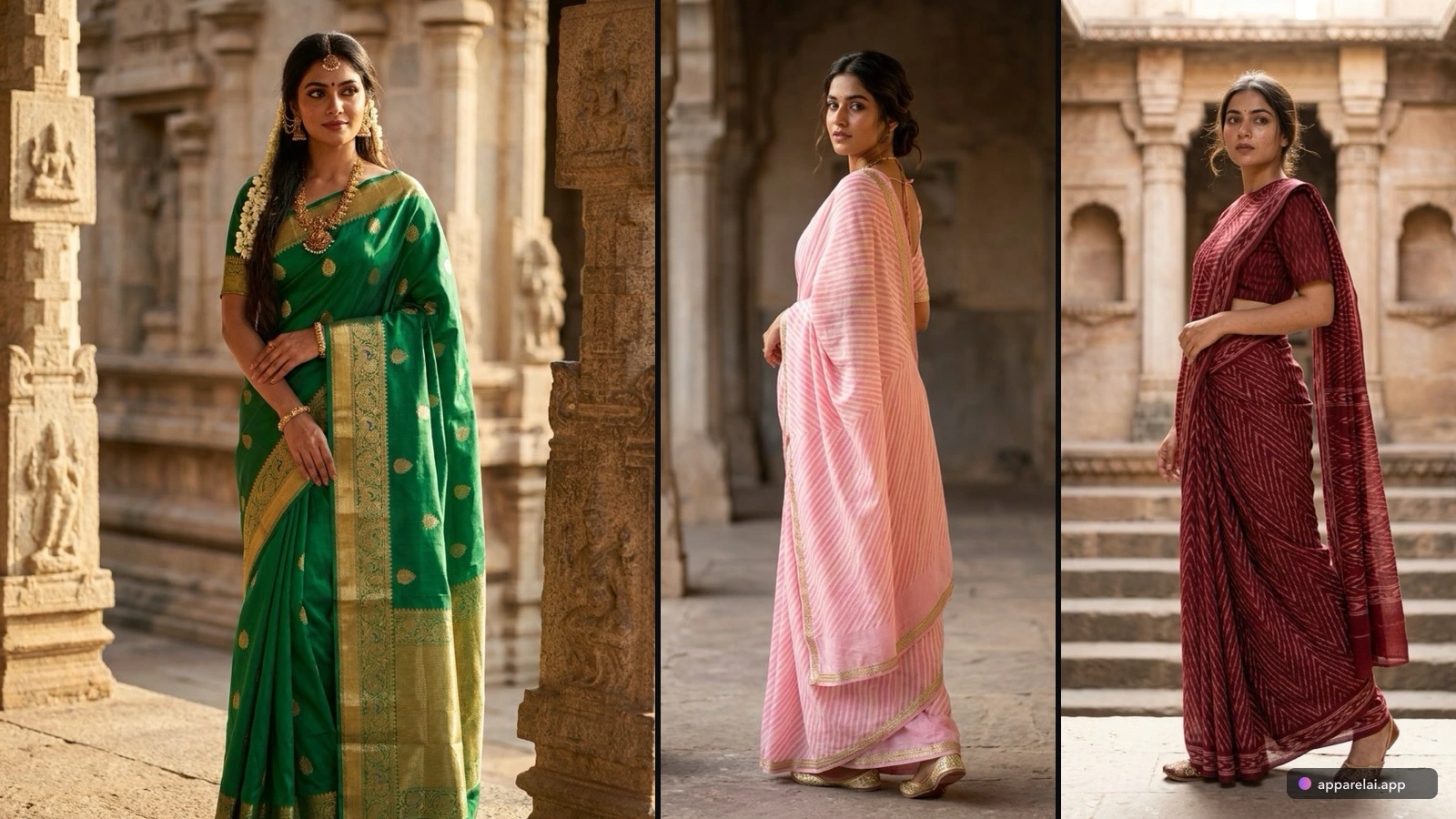
A saree photoshoot in India typically costs between Rs 800 and Rs 2,500 per piece, against Rs 300 to Rs 800 for simpler garments. Sellers in most apparel categories complain about photography costs. Saree sellers complain louder, and they are right to.
The per-garment economics of a saree shoot are genuinely worse than almost anything else in fashion, and it is not because photographers are overcharging. It is structural. Here is where the money actually goes.
The drape is skilled labour
In a kurti shoot, changing garments takes two minutes. The model steps out of one and into the next, and the camera keeps rolling. A good studio can move through 40 or 50 pieces in a day.
A saree does not work like that. Every single piece has to be draped from scratch: pleated at the waist, set at the correct length, the pallu arranged and pinned so it falls right on camera. Done properly, by someone who knows what they are doing, that is 30 to 45 minutes per saree.
That one fact reshapes the entire budget. Your shoot day is no longer limited by the camera or the model. It is limited by draping time, and draping time is a person's skilled hours.
Realistically a full studio day yields somewhere between 10 and 16 sarees. Against 40 to 50 kurtis in the same day, on the same crew cost.
What the day actually contains
For a proper saree shoot you are paying for:
- •Drape artist or stylist. Non-negotiable for anything beyond basic cotton. A badly draped Kanjeevaram photographs as a badly made Kanjeevaram.
- •Model. Booked by the hour or the day, and the clock runs during draping, when nothing is being shot.
- •Photographer and assistant.
- •Studio and lighting. Silk and zari need controlled light, which means a real setup rather than a window.
- •Steaming and prep. Sarees arrive folded and creased, and creases show badly on silk.
- •Post-production. Colour correction is unusually critical here, because saree colour is a primary purchase driver and screen-accurate maroon is hard.
Add it up in India and a saree shoot commonly lands at Rs 800 to Rs 2,500 per piece all-in, higher for bridal and heavy silk. That is meaningfully more than the Rs 300 to Rs 800 typical for simpler garments, and the gap is almost entirely draping time.
The reshoot rate is higher too
Saree shoots fail in ways other shoots do not.
The pallu falls wrong and hides the motif that justifies the price. The pleats sit unevenly and the drape looks cheap. The border disappears into a fold and the buyer cannot see the feature they are paying for. Zari blows out under a hard light and the gold reads white.
Each of those means re-draping, which means another 30 to 45 minutes, which means the piece you already paid to shoot costs you again. Nobody budgets for this and everybody experiences it.
The maths for a real catalog
Take a mid-size saree seller with 200 SKUs.
| Item | Traditional shoot |
|---|---|
| Draping time at ~35 min each | roughly 115 hours |
| Shoot days at 12 sarees a day | around 17 days |
| Cost at Rs 800 to Rs 2,500 per piece | Rs 1,60,000 to Rs 5,00,000 |
| Calendar time including prep, shoot, edit | 6 to 10 weeks |
| Reshoots | on top of all of the above |
Then the season changes, you add 60 new designs, and you start again.
This is why so many saree catalogs online are visibly stale, or mix three different photography styles from three different years, or fall back on supplier-provided images that twenty other sellers are also using.
What this costs beyond the invoice
The cash number is the visible part. The expensive part is what the constraint does to how you trade:
Catalog velocity. If listing a new design means waiting for the next shoot day, you cannot chase trends. You list when the studio is free, not when the market is ready.
Partial catalogs. Sellers shoot their top 30 designs properly and let the tail go up with weak images, so the tail never sells, which confirms the belief that the tail is not worth shooting.
Frozen catalogs. Refreshing creatives seasonally is a known ranking lever on marketplace feeds. At Rs 1,60,000 a refresh, nobody refreshes.
Marketplace ceilings. Premium platforms select on catalog quality. Weak saree imagery keeps you in the value tier regardless of the quality of the actual textile.
Where AI changes the maths, and where it does not
The part AI genuinely removes is the draping bottleneck. You photograph the saree flat, which takes minutes rather than the better part of an hour, and the drape happens in generation. That collapses both the cost per piece and, more importantly, the calendar.
For sarees the input has to be handled properly, because a saree is not one surface: the body, the pallu and the blouse piece are visually distinct and all three get scrutinised. Feeding them in separately through Saree Element Uploads is what keeps the output accurate rather than merely plausible. The full process is in raw saree photos to a finished photoshoot.
It also removes the second cost most sellers forget: the supporting images. A saree listing needs six to eight photos, and border close-ups, pallu flat lays, fabric swatches, embroidery details and blouse shots each used to be their own setup on the shoot day. Those now come from the same uploads, including the blouse on an invisible mannequin, and Color Variant covers additional colourways without a fresh shoot per variant. On a catalog where every design ships in four colours, that alone changes the arithmetic.
What AI does not remove is the value of real macro photography on genuinely premium pieces. At full zoom on a Rs 40,000 Banarasi, photographs of the actual zari carry the sale. The economics that work: AI for the on-model hero and the listing set, where draping and setup cost is the whole problem, and your own camera on the high-value pieces where authenticity is the whole point.
Bottom line
Saree photography is expensive because a saree has to be built on a body before it can be photographed, and that is a skilled job repeated for every single piece. Everything downstream, the shoot day yield, the reshoot rate, the stale catalogs, follows from it. Removing the draping bottleneck is what makes a saree catalog something you can keep current instead of something you shot once and live with.
Ready to try AI product photography?
Start with 3 free images. No credit card required.
Start Free Photoshoot