AI vs Traditional Fashion Photography: A Real Cost Breakdown
We broke down the actual costs of AI product photography versus traditional photoshoots for a 100-SKU fashion catalog. The numbers were eye-opening.
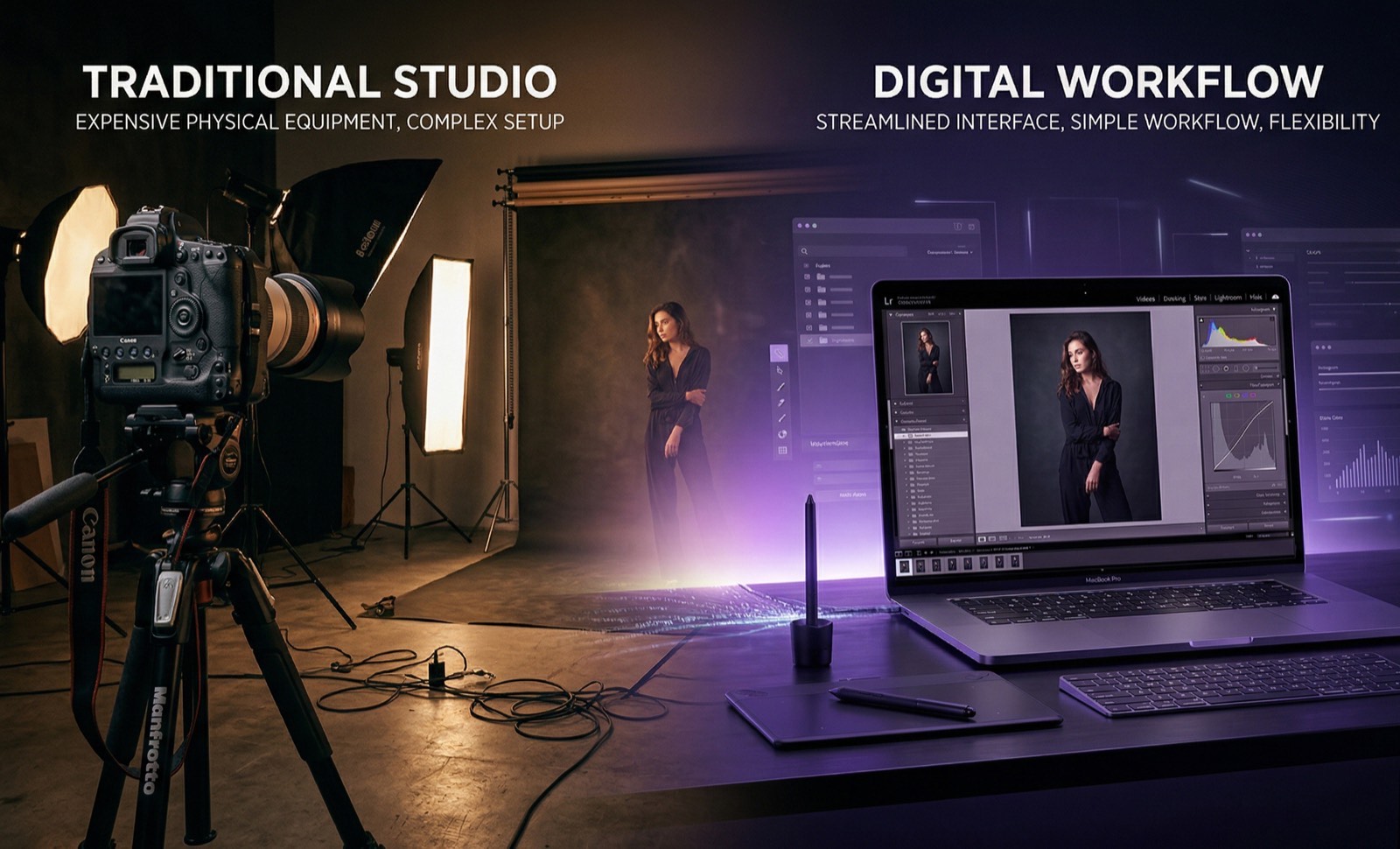
A brand we talked to recently spent $47,000 on product photography last year. They had 200 SKUs across four seasonal collections. That's roughly $235 per product image set. They wanted to know if AI could actually replace that.
The honest answer is: it depends on what you're comparing. Let's break down real numbers.
Traditional photoshoot costs (200 SKUs)
Here's what a typical mid-range fashion photoshoot budget looks like for a brand shooting 200 products over a year:
| Expense | Cost per session | Sessions/year | Annual total |
|---|---|---|---|
| Studio rental | $250/hr x 8hrs | 8 | $16,000 |
| Photographer | $2,000/day | 8 | $16,000 |
| Models (2) | $500/day each | 8 | $8,000 |
| Stylist | $400/day | 8 | $3,200 |
| Post-production | $15/image x 200 | - | $3,000 |
| Misc (props, travel, catering) | - | - | $2,500 |
| Total | $48,700 |
This doesn't include reshoot costs (industry average: 15% of images need reshooting), management overhead coordinating schedules, or opportunity cost of delayed product launches.
AI photography costs (200 SKUs)
Using a platform like ApparelAI Studio with a Business plan:
| Expense | Cost | Annual total |
|---|---|---|
| Monthly subscription ($50/mo) | $50 x 12 | $600 |
| Extra image credits (if needed) | - | $200 |
| Time spent uploading/generating | ~20 hrs/year | Staff time |
| Total | $800 |
That's roughly 98% less. But cost alone doesn't tell the full story.
Where traditional photography still wins
High-end editorial campaigns. If you're shooting a lookbook that tells a story with specific locations, lighting moods, and brand narrative - AI can't replicate that creative direction fully. Not yet, at least.
Complex styling. Layered outfits with accessories, specific poses interacting with environments, group shots - these push current AI capabilities.
Brand heritage content. When the photoshoot itself is part of your brand story (behind-the-scenes, designer involvement), there's no substitute.
Where AI photography wins decisively
Catalog-scale product imagery. When you need consistent, professional model shots across hundreds or thousands of SKUs, the economics are overwhelming.
Speed to market. Traditional: 2-4 weeks from shoot to final images. AI: same day. For brands dropping new products weekly, this matters.
Iteration and testing. Want to see that jacket on three different model types? With traditional: three separate bookings. With AI: three clicks, five minutes.
Seasonal refreshes. Updating backgrounds from summer to fall across your catalog. Traditional: reshoot everything. With an AI background changer, you batch update backgrounds in an afternoon.
Size-inclusive imagery. Showing garments on diverse body types costs nothing extra with AI. Traditionally, each body type requires a separate model booking.
The hybrid approach most brands land on
After talking to dozens of brands that made the switch, the pattern we see is this:
- •Hero products and campaigns: Still shot traditionally (10-15% of catalog)
- •Catalog product images: AI-generated (80-85% of catalog)
- •Supplementary angles: Mix of AI model shots, flat lays, and detail photos
This gives you the editorial quality where it matters most while keeping catalog costs under control.
The math that actually matters
It's not just about the photography line item. Consider:
Faster time-to-market: Products go live days earlier, capturing early sales that slower competitors miss. One brand reported a 12% revenue increase just from faster product launches.
Higher conversion rates: On-model imagery consistently outperforms flat lays and mannequin shots. Brands switching from flat lays to AI model shots report 15-30% improvement in conversion.
Lower return rates: When shoppers can see how garments look on a body similar to theirs, they make better purchase decisions. Average return rate improvement: 10-15%.
Reduced operational complexity: No scheduling, no model agencies, no weather cancellations, no reshoots.
The bottom line
If your photography budget is a meaningful line item and you're shooting more than 50 products a year, AI photography pays for itself almost immediately. The quality gap has narrowed to the point where most shoppers can't distinguish AI model shots from traditional ones in a product listing context.
The question isn't really "AI or traditional" anymore. It's "how much of my catalog warrants the traditional approach." For most brands, that number is smaller than they think.
Ready to try AI product photography?
Start with 3 free images. No credit card required.
Start Free Photoshoot