Dropshipping Product Photos with AI
Your competitors use the same supplier photos. Here is how dropshippers use AI to create branded product imagery.
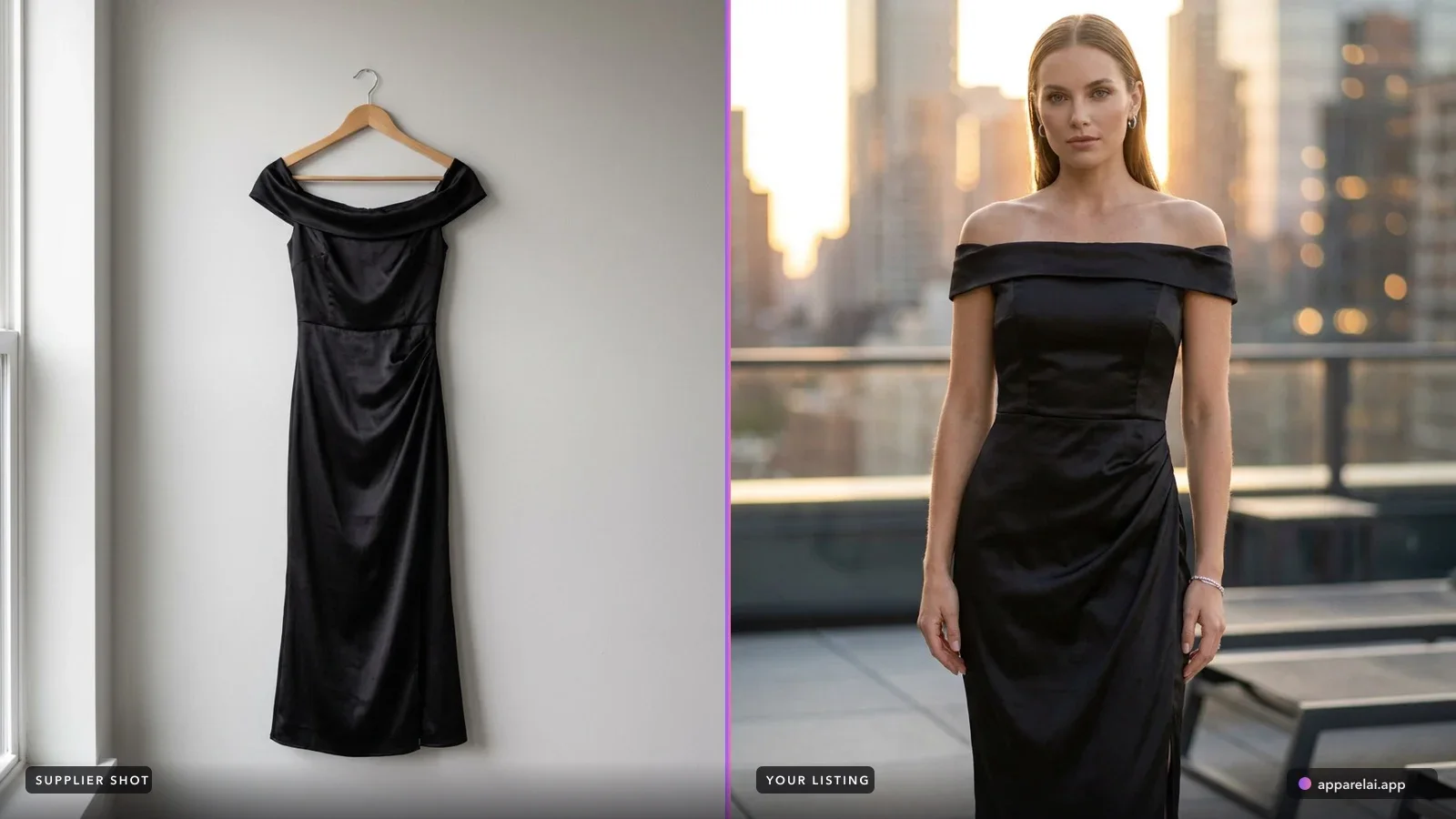
The core problem with dropshipping is simple: you don't have the product. You can't hold it, style it, or photograph it. You're relying on whatever images your supplier provides.
And so is every other dropshipper selling that exact same product.
When 50 stores use the same AliExpress product photos, no store has a visual identity. Buyers see the same images across multiple listings at different prices and choose the cheapest one. Your marketing, your brand story, your positioning? Irrelevant. You look identical to everyone else.
What most dropshippers do (and why it fails)
Using supplier photos directly: The default option. Quick, free, and indistinguishable from your competitors. Some supplier photos are also watermarked, low-resolution, or have distracting Chinese text in the background.
Ordering samples for photography: The proper way to do it. Order 10-20 hero products, photograph them professionally, and use those images. Problem: this costs $200-500 per product in photography plus the sample cost and shipping time. For a store testing 50+ products, the economics don't work until you know which products sell.
Using mockup generators: Better than supplier photos, but templates look generic. Experienced shoppers recognize the same mockup templates across stores and lose trust.
The AI approach: transform supplier photos into branded images
Here's what's actually working for dropshippers now:
Step 1: Download your supplier's best flat lay photo. Most AliExpress and 1688 suppliers include at least one clean flat lay or garment photo. Pick the clearest one with the best lighting.
Step 2: Upload to an AI photography tool. The AI strips the garment from the supplier's photo, analyzes its shape and details, and prepares it for model generation.
Step 3: Generate on-model shots with your brand identity. Choose a model that represents your target customer. Pick backgrounds that match your store's aesthetic. Generate consistent imagery across all your products.
The result: Your product listing now features unique model photography that no other dropshipper has. The garment is the same, but the presentation is yours.
The cost math
For a dropshipping store with 100 active products:
| Approach | Cost | Uniqueness | Quality |
|---|---|---|---|
| Supplier photos | Free | None | Variable |
| Sample + photoshoot | $20,000-50,000 | Complete | Highest |
| Mockup templates | $100-500 | Low | Medium |
| AI model photos | $200-1,000 | High | High |
AI photography gives you 80% of the benefit of custom photoshoots at 2-5% of the cost. And you don't need to order a single sample.
What works and what doesn't
Works well:
- •Standard fashion items: t-shirts, dresses, hoodies, casual wear
- •Products with clear, clean supplier photos as input
- •Products where the garment shape is simple and well-defined
Requires care:
- •Products with specific material textures that matter (leather, silk)
- •Items where color accuracy is critical (buyers are particular about shades)
- •Products with complex details (embroidery, hardware, prints with small text)
Doesn't work well:
- •Products where the supplier photo is blurry, poorly lit, or taken at a weird angle
- •Multi-piece outfits where coordination matters
- •Products where the supplier photo doesn't show the full garment
The quality of your output is directly tied to the quality of your supplier's input photo. If the supplier photo is garbage, AI can't save it.
Building a brand look as a dropshipper
The real power of AI photography for dropshipping isn't just making individual product photos better. It's creating a consistent brand experience across your entire store.
Persistent model: Use the same AI model across all your products. This creates a recognizable brand identity even though you're selling products from different suppliers.
Consistent backgrounds: Choose one or two background styles and apply them to everything. White for marketplace listings, a lifestyle background for your DTC store.
Consistent style: Same lighting, same poses, same editing treatment. When someone browses your store, it should feel like a cohesive brand, not a random collection of supplier photos.
This consistency is what separates dropshipping stores that build real brand equity from ones that look like throwaway test stores.
The testing advantage
Dropshipping is a testing game. You list products, run ads, see what sells, and double down on winners. AI photography accelerates this cycle:
- Find a product on AliExpress
- Download supplier photo
- Generate AI model shots in 60 seconds
- List on your store immediately
- Start testing with ads
No waiting for samples. No booking photographers. No 2-week delay between finding a product and listing it. You can test 20 products in an afternoon.
When a product proves itself as a winner, that's when you order samples, do real photography for marketing campaigns, and invest in the product properly.
Bottom line
Every dropshipper knows that supplier photos are a liability. The stores that break out of the commodity trap are the ones that create a unique visual identity. AI photography makes this possible without the traditional cost barriers. You're still selling the same product, but you're selling it better than everyone else who's using the same tired supplier images.
Ready to try AI product photography?
Start with 3 free images. No credit card required.
Start Free Photoshoot